
Pokémon card centering: how to check it before you grade
What 55/45 and 60/40 actually mean, how to measure them on your own cards, and the centering each grading company needs for a 10.
Short answer
For a PSA 10, the front of the card should be centered about 55/45 or better and the back 75/25 or better. To check, measure the border on each side, divide the wider one by both added together, and do it for left/right and top/bottom on the front and back. The worst of those numbers is the one that counts.
What centering means
Every Pokémon card has a border around the artwork, usually yellow on English cards. Centering compares opposite sides of that border. If the left and right borders are exactly the same width, the card is 50/50 left to right. If the left border takes up 60% of the combined width and the right takes 40%, the card is 60/40.
Graders look at both directions (left/right and top/bottom) on both sides of the card. A card can look perfect left to right and still be well off top to bottom, so always check both.
How to calculate centering
Measure the two opposite borders, then use this formula:
That gives the first number, and the second number is whatever is left to reach 100.
Worked example
Say the left border is 3.0 mm and the right border is 2.2 mm. Together that's 5.2 mm. 3.0 ÷ 5.2 = 0.577, so the card is about 58/42 left to right.
Then check top to bottom. If the top is 2.6 mm and the bottom is 2.8 mm, that's 2.8 ÷ 5.4 = 52/48.
The worse direction is the one that matters, so this card's front centering is 58/42. That misses PSA's roughly 55/45 limit for a 10, but it's inside the range PSA allows for a 9.
Centering limits by grading company
These are the centering limits each company publishes for its top grades. Centering is only one part of the grade, so meeting it doesn't guarantee the grade. Missing it, though, rules the grade out.
| Grade | Front | Back |
|---|---|---|
| PSA 10 Gem Mint | ~55/45 | 75/25 |
| PSA 9 Mint | ~60/40 to 65/35 | 90/10 |
| CGC Pristine 10 | 50/50 | 50/50 |
| CGC Gem Mint 10 | ~55/45 | 75/25 |
| BGS Pristine 10 | 50/50 | 55/45 |
Based on PSA's grading standards, CGC's grading scale, and Beckett's grading scale, checked November 2026. Companies update their standards, so check their sites before a big submission. PSA also says graders can make a judgment call on eye appeal for borderline cards.
Three ways to check your cards
1. A ruler or digital caliper
A digital caliper gives the most precise reading. A millimeter ruler works too, but the borders are only a few millimeters wide, so a half-millimeter misread can change the result by several points. Measure at the middle of each edge, not near the corners.
2. A straight-on photo
Lay the card flat on a dark surface, hold your phone directly above it, and take the photo without zooming. Then measure the borders in any photo editor and use the formula. A photo taken at even a slight angle stretches one side of the card, so the near border looks wider than it really is. If your numbers look strange, retake the photo.
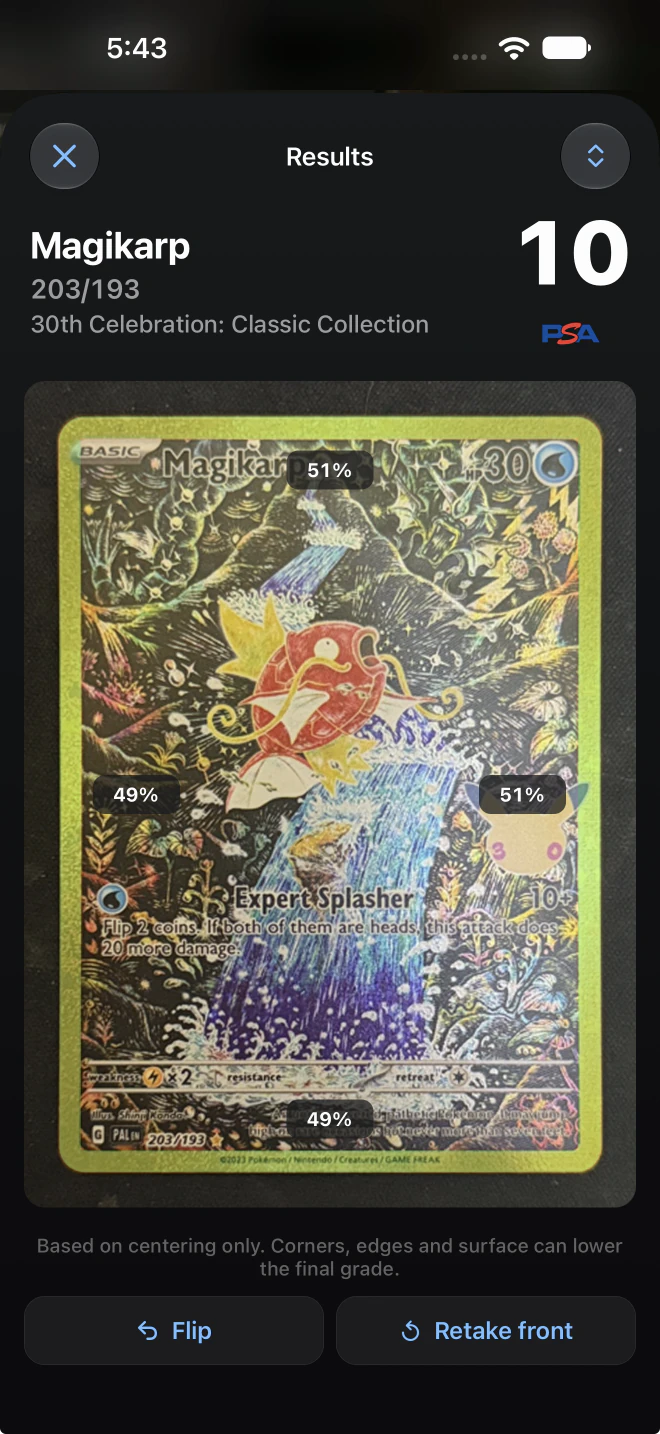
3. The River app
River's centering check does the measuring for you. Take a photo of the front and the back, and River finds the borders, calculates left/right and top/bottom centering, and shows which grade the centering alone could reach at the major grading companies.
Common centering mistakes
- Only checking left and right. Top/bottom centering is easy to miss, and it counts the same.
- Skipping the back. The limit is looser than on the front, but a very off-center back can still lower the grade.
- Measuring through a sleeve or top loader. The plastic edges hide the card edge and add glare. Take the card out (carefully) before measuring.
- Trusting a tilted photo. A small angle can turn a 55/45 card into what looks like 60/40, or the other way around.
- Grading a card just because it's valuable. If the centering rules out a 10, work out whether a 9 is still worth the grading fee before you send it in.
Centering is only part of the grade
Graders also look at corners, edges, and surface (scratches, whitening, print lines). Centering is the best place to start anyway, for two reasons: it can't be fixed, and it's the easiest of the four to measure at home. If a card passes centering, then go over its corners, edges, and surface under a bright light.
Questions
Can a 60/40 card get a PSA 10?
Usually not. PSA's Gem Mint 10 standard asks for front centering of approximately 55/45 or better, so a clear 60/40 front normally tops out at a PSA 9. Graders can make an eye-appeal judgment call on borderline cards, but you should not count on one.
Does back centering matter?
Yes, but the limits are much looser. PSA and CGC allow about 75/25 on the back for a 10. The back is easy to forget, so check it before you submit.
Can centering be fixed?
No. Centering comes from how the card was cut at the factory, so it cannot be improved. That makes it the best thing to check first: a card that misses on centering will miss no matter how clean its corners and surface are.
Is centering the same at every grading company?
No. PSA 10 and CGC Gem Mint 10 both allow about 55/45 on the front, while CGC Pristine 10 and BGS Pristine 10 need 50/50. The same card can meet one company's top grade and miss another's.